Category: Politics

There are two ways to vote for the Senate in Australian elections. One way (“above-the-line”) is simple and quick, but it means the politicians you vote for get to control who gets to use your vote if they don’t win. Why should you hand your power over to them like that? The other way gives you 100% control: it’s called “below the line” voting, but it’s a lot more involved. Here in the state of Queensland, we have 82 people running for the Senate in this Saturday’s election, so if I want to vote “below the line”, I have to fill out every single box next to each candidate’s name, from 1 to 82.

This is complex, so only about 3.8% of people do it across Australia. And it still has disadvantages. Even if I have no strong opinions on more than a few parties, or even if I ONLY want people from a few parties to get in and actively don’t want anyone else to use my vote, I still have to pretend that I like the person who gets my “50” vote more than the one who gets my “82” vote. I’m pretty interested in and engaged with politics, but there’s no way I have an opinion on 82 different people. There’s only ten people I actively want to support in this election, and I reckon groups like Family First and One Nation are just as bad as each other. So are parties like the Sex Party, Animal Justice Party and Senator Online Party, who did grubby deals that give One Nation’s Pauline Hanson a very good chance of winning a seat.

Fortunately, there’s a little trick hidden away in the law about how the votes are counted. The trick is probably meant to make sure people who make honest mistakes filling out the ballot paper still get to have their vote counted. But we can manipulate this trick to make sure that only the people we actually WANT to vote for get to use our vote.

THE TRICK:

1) Vote for the candidates you actually want to get in. I have ten people I want to support, so I am going to vote 1-10 for them.

2) MAKE A DELIBERATE MISTAKE. The best way (in my case) is to write down the number 11 twice.

3) Then you have to fill in all the rest of the boxes. The order does not matter one bit, so you can just start from the left and go to the right. But you HAVE to fill them all in consecutively. I’m going to start from 13, so that I know the last number I write still has to be 82. You can also write from 12-81, as Dr Cam Sexenheimer pointed out on Twitter this morning.

So, what exactly will this do, and what are the risks?

It means that only the top ten people I voted for will get to use my vote. If none of them get elected, my vote will just drop out and not go to anyone. Because I voted “11” twice, the rules say the vote-counters can’t know who I wanted to “really” vote for. But the other rule they put in to make sure votes with a couple of honest mistakes get counted means my vote gets counted, too.

Yes, but what about the risks?

The first risk is that you make too *many* errors and your vote doesn’t get counted at all. The rule says that IF:

You could correct three (or fewer) of the numbers on your voting paper,

and IF those corrections would mean 90% or more of the numbers were filled out properly

THEN your vote counts.

That means if you made FOURTEEN numbering errors (including your deliberate error), your vote would simply not be counted at all. For instance, if you voted 1,2,3,3,3,3,3,8,9,10… your vote WOULD be counted because changing three of your numbers would mean 90% or more of the boxes were filled out correctly. But if you voted 1,2,3,3,3,3,3,3,3,3,3,3,3,3,3,3,17,18,19… your vote would NOT be counted because changing three numbers would still leave ten boxes labelled incorrectly, and 10 out of 82 means you’ve only filled in 88% of the boxes correctly.

Yes, that’s a little complex. So if you’re going to take advantage of this hack, make sure you only make ONE error, the deliberate error. Because if you vote this way, and if the race is tight when your vote gets counted, there will be angry, smart politicians who know the rules backwards arguing VERY LOUDLY INDEED about whether your vote is valid or not. So why give those major-party-mongrels the pleasure of throwing your vote out?

There’s also a deeper risk I should mention. When you run for the Senate, you normally have to get about 14% of the vote to win. If none of the people you vote for wins a seat, your vote drops out of the count completely. That means the 14% someone needs to win gets a tiny bit smaller. If, say, 100,000 people were to vote this way in Queensland, and all their votes dropped out, that means the candidates still in the race would need about 14,000 fewer votes to win a seat. It’s practically impossible to predict beforehand how this sort of thing is going to play out at an election, with complex interlocking preference deals between dozens of different parties, but it could possibly lead to weird results you don’t want.

So, think about those risks before you do this. I’m prepared to risk it myself, so I am definitely going to vote this way. It’s not a huge thing really, but it’s good to be able to assert control over my life in small ways, and large ones too.

NOTE: Amusingly enough, I got turned onto this trick by the loathsome @Karwalksi of the Wikileaks Party, who thinks exposing their website’s visitors to US Government spying is cool and edgy.

NOTE: Similar info to this was published over a week ago on the Indpendent Australia website. However there are errors in that post, including the idea that the revolutionary communist activist formerly known as Albert Langer (who now chooses to be known as Arthur Dent, NOT “Albert Langer”) “discovered” this loophole.

SOURCES:

1) Tweets from the Australian Electoral Commission this morning:

2) The official guidelines the Electoral Commission use to decide if a vote gets counted or not
3) Section 270 of the Commonwealth Electoral Act.

Editorial: Is Rudd Being Briefed By Obama To Support Intervention On Syria?

Obama, in a speech today amid a worsening situation in Syria, downplayed the possibility of US intervention without a UN mandate and the backing of a coalition:  “If the U.S. goes in and attacks another country without a U.N. mandate and without clear evidence that can be presented, then there are questions in terms of whether international law supports it — do we have the coalition to make it work?”  On the surface, Obama’s speech appears to be advising caution on Syria, but similar language has been used prior to previous wars.  Is this speech a veiled call to former Iraq War coalition partners?

Rudd has called a halt to the election campaign today in order to seek a briefing about the situation in Syria.  And on September 1st, Australia will begin it’s one month tenure as President of the UN Security council.  Is the briefing Rudd is seeking really about the US wanting Australia to exert pressure on the Security Council in favour of intervention?

Time will tell.

PNG Solution Protests Sweep Australia

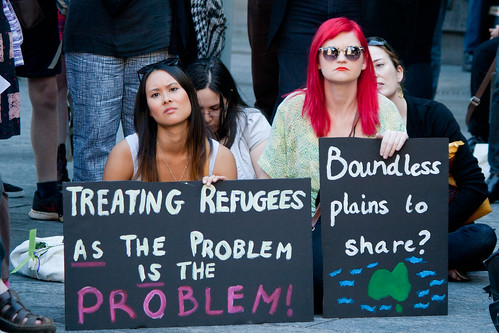
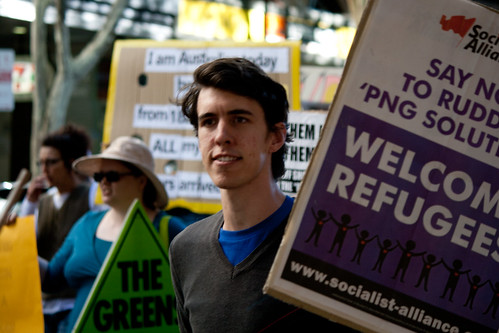
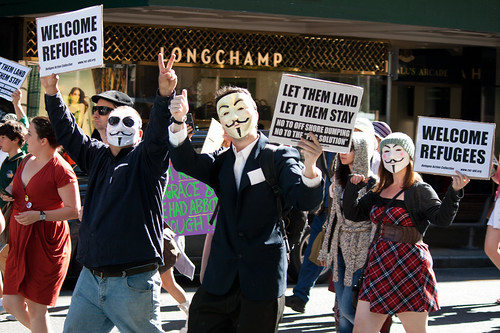
Today marked a National Day of Action in protest against the government’s PNG Solution.

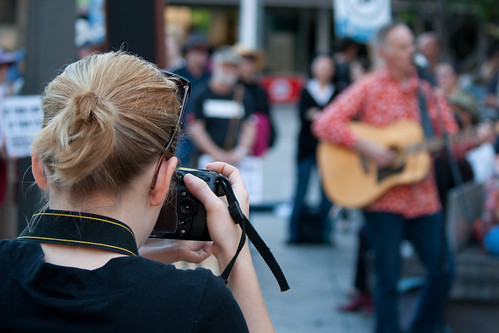
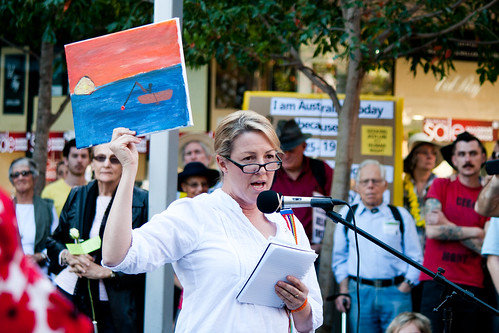
3000 People nationwide marched in capital cities, with Melbourne leading the largest rally.  In Brisbane, speakers Penny Spalding from the Queensland Teachers Union, Greens candidate Rachel Jacobs, St Mary’s priest in exile Terry Fitzpatrick and other speakers addressed a crowd of 250, before taking to the streets.

Speech audio is available here (Audio recordings courtesy of David Jackmanson).

Photos of the Brisbane rally can be seen by going here, or viewing the small selection below:

PNG Solution Protest 24 Aug 2013

PNG Solution Protest 24 Aug 2013

PNG Solution Protest 24 Aug 2013

PNG Solution Protest Aug 24 2013

PNG Solution Protest 24 Aug 2013

PNG Solution Protest 24 Aug 2013

PNG Solution Protest 24 Aug 2013

Press Release: Melbourne Baptist Pastor to defend Ploughshare accused

Peace Convergence: Media Release 10 August 2013

Melbourne Baptist Pastor to defend Ploughshare accused

The Reverend Simon Moyle of the GraceTree Community in Melbourne will be coming to Rockhampton to support and defend Graeme Dunstan in the Tiger Ploughshare trial which will begin the Rockhampton District Court on Monday 19 August

Mr Dunstan is charged with a wilful damage of an Australian Army Tiger Armed Reconnaissance Helicopter on the tarmac of Rockhampton airport during Talisman Sabre 2011. His co accused, Bryan Law, who actually struck the blow with the garden mattock, died last Easter.

The Reverend Moyle describes Mr Dunstan as “a spiritual companion” and says Dunstan’s willingness to risk jail and suffering in order to arouse the conscience of the Australian community on war demonstrates integrity of the highest order, not to mention exemplary citizenship.

“Civil disobedience is generally not well understood in this country,” observes the Rev Moyle. “But it is one of the highest duties of any person when their government is acting immorally or unjustly.”

Ploughshares actions take their inspiration from the Biblical books of Micah and Isaiah, which speak of a day when “swords will be beaten into ploughshares, and spears into pruning hooks”.

There have been more than 80 such actions since 1980, with three common elements:
1. being absolutely nonviolent towards people;
2. to remain and take responsibility for the action; and
3. to make some attempt to disarm a weapon and begin its transformation into something useful.

Disarmament is often seen as an impossible dream; desirable, certainly, but utterly unrealistic. It is precisely this societal torpor that Ploughshares actions seek to address.

Ploughshares actions are an indictment on the imagination and moral commitment of contemporary society just to the extent that they are seen as outrageous, destructive, or utopian.

While most of us ask, “Why would we reduce or even give up our ability to kill?”

People like Graeme Dunstan and Bryan Law gift us with a confluence of flesh, steel and carbon fibre, and ask, “Why not?”

“In a time of perpetual war, it is high time we took that question seriously,” said the Rev. Moyle.

See full statement here.


Further information

http://peaceconvergence.wordpress.com/ploughshares-trial/

FaceBook event http://www.facebook.com/events/169657596540366/?fref=ts

Simon Moyle smoyle@gmail.com 0402 857 915

Graeme Dunstan 0407 951 688

The Wikileaks Party in Australia is officially on the ballot in elections due to be held by November 30 this year. Wikileaks’ founder and its most famous personality, Julian Assange, will run for the Senate in the state of Victoria. On Thursday July 25 2013 they announced their slate of candidates, only to immediately suffer a DDOS attack for which US hacker @th3j35t3r claimed responsibility.

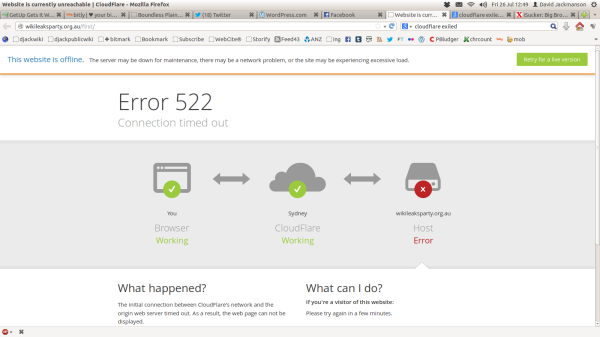
On July 26 the Wikileaks Party website was still down. An error message was provided by Cloudflare , a company which assists websites in surviving attacks by monitoring their traffic, detecting hostile activity and blocking that activity before it stops the original website working:

Wikileaks Party using Cloudflare

Cloudflare is already credited with protecting the main Wikileaks website from a DDOS attack in August last year. However, Cloudflare has a more sinister side, one that should give anyone connected with Wikileaks second thoughts about trusting any private information to it, and that knowledge has been public since 2011 thanks to Yasha Levine writing in The Exiled. Cloudflare founder Matthew Prince has a long history of working directly with US law enforcement, since he managed the anti-spam Project Honey Pot in 2003:

“Mr. Prince has…focused effort on providing enforcement officials with the necessary information and tools to prosecute violators of the federal CAN-SPAM Act and other anti-spam laws. To that end, Mr. Prince managed the development of Project Honey Pot, an Unspam community-service project that consists of a distributed system of decoy e-mail addresses that website administrators can include on their sites in order to gather information about the robots and spiders that spammers use”

So Prince happily says he has already started one company to work directly with US Federal law enforcement. His current project, Cloudflare is potentially even closer to the national security apparatus:

“We ran [Project Honey Pot] as a hobby and didn’t think much about it until, in 2008, the Department of Homeland Security called and said, “Do you have any idea how valuable the data you have is?” That started us thinking about how we could effectively deploy the data from Project Honey Pot, as well as other sources, in order to protect websites online. That turned into the initial impetus for CloudFlare”.

So, while the Wikileaks Party says it will be “fearless in its opposition to the creeping surveillance state, driven by globalised data collection and spying agencies”, and says it supports protection for whistleblowers, the Party is funnelling all traffic to its website through computers belonging to a company with close and friendly links to that very same surveillance state. This could give the US government very easy access to the IP address of all visitors to the Wikileaks Party website. How could this hurt Wikileaks supporters?

Well for example, one day Wikileaks may well release official Australian information that is embarrassing to the the US government. If the US Government had already issued a National Security Letter to Cloudflare telling it to retain details of which IP addresses visited the Wikileaks Party site, they could look at those records and see if anyone had visited the Wikileaks Party website from a government computer, or if an unusual or new pattern of visits had been logged in the time before the leak. If anything looked promising, for instance if many visits were logged from an Internet cafe that had never accessed the website before, that may well narrow the search for the leaker down a lot. Comparing records of visitors to both the Wikileaks’ Party website and the main Wikileaks website could make it yet easier to track down a would-be-anonymous leaker. These sort of techniques are how General David Petraeus’ lover was tracked down last year after she sent threatening emails from anonymous addresses connected to hotel Wi-Fi networks last year.

If we take Cloudflare’s assurances at face value, however, we have nothing to worry about. They tell us “If the NSA is listening in on any transactions traversing our network, they are not doing so with our blessing, consent, or knowledge“, and in the same post on the company blog they go into some detail about how SSL is used to encrypt traffic on Cloudflare, and why they think it is unlikely that the NSA is able to break Cloudflare’s 2048-bit encryption. Which is a lovely story to tell children at bedtime, but utterly irrelevant to your online privacy. What SSL does is encrypts your messages. So if you sent me an email saying “Let’s go to the pub tonight”, and I sent you an email back saying “Great!”, then an online snooper wouldn’t be able to read the contents of our messages. But what they could know is that you had sent me a short email, and that I had sent you a short email in reply. If that snooper already knew that the two of us often go to the pub, and that we usually arrange our drinking by email, it’s pretty easy to work out, without breaking any encryption, where she could snoop on us that evening. This is described in much more detail in a paper by Shuo Chen, Rui Wang, Xiao Feng Wang and Kehuan Zhang (pdf file):

“Specifically, we found that surprisingly detailed sensitive information is being leaked out from a number of high-profile, top-of-the-line web applications in healthcare, taxation, investment and web search: an eavesdropper can infer the illnesses/medications/surgeries of the user, her family income and investment secrets, despite HTTPS protection; a stranger on the street can glean enterprise employees’ web search queries, despite WPA/WPA2 Wi-Fi encryption”.

So the NSA may not be “listening in”. But they don’t have to listen in, as such, to find out a lot about you.

What has Cloudflare already provided the US government? We can get some idea by looking at another part of that Cloudflare blog post:

“To date, CloudFlare has never received an order from the Foreign Intelligence Surveillance Act (FISA) court…As a policy, we challenge any orders that have not been reviewed and approved by a court. As part of these challenges, we always request the right to disclose at least the fact that we received such an order but we are not always granted that request…CloudFlare fully supports the calls for transparency today by other web companies like Google, Microsoft, and Facebook. At a minimum, we request the law be updated to allow companies to disclose the number of FISA orders and National Security Letters (NSLs) they have received”.

So Cloudflare mentions orders from the secret FISA court, and National Security Letters. They deny that they’ve ever received FISA orders, but don’t deny receiving any National Security Letters. So we can infer that they have received NSLs, and that they have complied with them. In their security policy they say:

“It is possible that CloudFlare may be required by court order to provide information about our customers. CloudFlare may also be required to provide information pursuant to law, applicable regulation, subpoena or other legal process”.

Which once again implies that while they may challenge orders that are not issued by a court, in the end they are willing to comply with US Government orders for information.

When I asked the Wikileaks Party on Twitter why they were using Cloudflare, I was answered by their Chief Technology Officer who apparently chooses to be known online only as @karwalski. Karwalski said that Cloudflare was keeping the site online despite the attack. When I asked why Wikileaks was funnelling information through servers of an organisation closely linked to the national security state, karwalksi asked if I had an alternative suggestion. I responded that it wasn’t my job to help Wikileaks do it’s job of protecting the privacy of visitors to its site (19), and was told:

“Ok, you had better not ever be a passenger or driver of a car, they are dangerous. Cool logic dude“.

So that’s what the Wikileaks Party in Australia thinks of your privacy. If you’re ever thinking of leaking anything to anyone, don’t let it be to Wikileaks – you can’t trust them with your online security.

—-

UPDATE:

After a week of me calling out the Wikileaks Party by name on Twitter about the privacy risks with their website, Assange’s running-mate in Victoria, Leslie Cannold, finally decided to respond tonight (Monday August 12 2013), when Twitter user @BenHarkin asked her about it:

It’s not my area of control or expertise. If tone were different I would have referred it. But rude irks me. @benharkin @djackmanson

So, there’s some handy information. If you want to hold the Wikileaks Party accountable for anything bad they might be doing, remember that you have to ask nicely, or they don’t have to worry about it.

UPDATE TWO:

Cannold thinks my rude, aggressive, presumptious tone should insulate the WikiLeaks Party from answering questions about the security risk its website poses to visitors:

U r outrageously rude & entitled. I wouldn’t dream of following yr barked orders in real life & won’t online. @djackmanson @benharkin

I thought Wikileaks was all about aggressive journalists demanding answers and accountability from the powerful?

Protesters Gather at Luggage Point to Protest US Warship

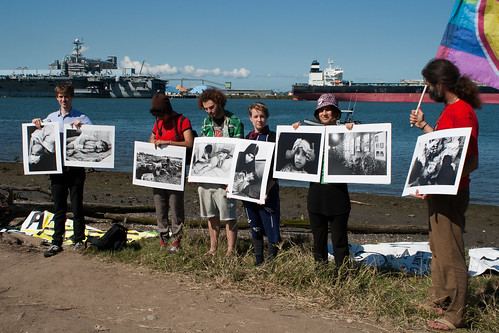
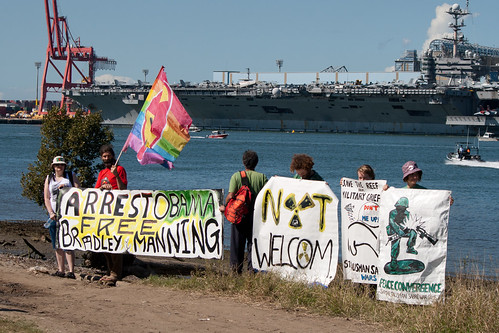
Members of Peace Convergence, The Greens and other anti-war groups met today at Luggage Point to share their message of peace.

Headline for the protest from Robin Taubenfeld: “US nuclear warship in our port? US-AUS games in our region? Bombs dropped on the reef? Bradley Manning in prison? Live firing and bombing practice are planned for this weekend at Shoalwater Bay! Just say no! ”

The protest was small but attracted interest from sightseers, including a US navy sailor scrutinising the protesters through Binoculars.

Photos below.

(full photoset here)


Anti-War Protest USS George Washington
Protester show pictures of war affected children from Iraq.

Anti-War Protest USS George Washington
Displaying the banners.

Anti-War Protest USS George Washington
Peace Flag.

Anti-War Protest USS George Washington

Anti-War Protest USS George Washington
Andy Paine sings some peace songs.

Editorial: Can NSA XKeyScore Operatives Access All Your Data?

There is a very good article on The Guardian at the moment that exposes more detail about NSA data collection (see here) but I would question some of the conclusions. The headline makes it seem like XKeyscore is collecting all internet activity on every user but this is not the case. The term used by the NSA material, “nearly everything a typical user does on the internet”, means that they collect nearly all the types of data an internet user generates: browsing history, email, chat, social media etc. Not that they collect all the information in those data classes for all users.

The XKeyscore database collects data from various sources including prism, ISP taps etc. It can hold the data usually for only 3 days or so before it has to be rolled off to make room for new data.

When Snowden says all he needs is an email and he can access all the data for any individual, he has to be exaggerating. For a start pop email accounts download mail from the server onto the end user’s computer which is protected behind a home or business hardware firewall – NSA will not be able to access this data just by “filling in an online form”. Also people with their own domains may or may not be hosted on ISP’s for which NSA have onsite ‘taps’. Users whose email address on social media is different to their personal email address will not be so easily connected – for example the address max@xxxxxx.net.au has no connection with the user’s facebook page.

What Snowden is talking about is the user whose online identity is connected through various cloud providers – for example one email address that forms the basis of their webmail (example gmail which includes email, browsing history etc), facebook, dropbox and so on. For those users, through Prism, an almost complete online history is recoverable. For other online users there will be varying levels of data able to be recovered.

XKeyscore seems to be a data collation program, bringing together data from various NSA sources, as opposed to an overarching data collection mechanism laid over the internet as Snowden and the Guardian article seem to be inferring.

Other than this exaggeration on the part of Snowden, and on the part of the Guardian in the way they have headlined the article, there is some high quality information and is well worth a read.

Sri Lankans face return to Colombo or transfer to PNG

Media Release from Department of Immigration and Citizenship:

Sri Lankans face return to Colombo or transfer to PNG
30-07-2013

A group of 68 Sri Lankans who recently arrived at Cocos (Keeling) Islands is now on Christmas Island about to begin enhanced screening processes.

They face the same assessment process that unauthorised maritime arrivals (UMAs) of Sri Lankan background have since last year when the Department of Immigration and Citizenship (DIAC) took steps to stem a significant upsurge in boat arrivals from Sri Lanka.

“Those who are screened out will be returned to Colombo as soon as possible, often within days,” a DIAC spokesman said today. “If any of the group is screened in, they will not come to Australia for assessment; they will be among the first Sri Lankan boat arrivals sent to Papua New Guinea for processing.

“If they are entitled to asylum, they will not be able to settle in Australia; they will be settled in PNG.”

The Sri Lankans began their enhanced screening as arrangements were finalised for the first transfer of people affected by the post-July 19 regional settlement arrangement to Manus Island in Papua New Guinea.

Under new rules announced on July 19, anyone – including a person from Sri Lanka – who arrives in Australia by boat without a visa no longer has the chance to settle in Australia.

“If they are not quickly returned to Colombo, they will be taken to Papua New Guinea where their claims will be assessed,” the spokesman said.

The prime ministers of Australia and Papua New Guinea signed the new agreement, meaning all people arriving by boat without a visa from July 19 will be sent to Papua New Guinea, where their claims will be assessed.

If people are found to be refugees, they will be permanently settled in Papua New Guinea – not Australia.

“The message this agreement sends is clear: the dangerous boat journey is not worth it and you will never settle in Australia,” the spokesman said. “Accommodation is being expanded on Manus Island and there is no cap on the number of people who can be transferred there.”

Almost 1300 Sri Lankans have been sent home since August 2012 – nearly 1100 of them involuntarily.

“These arrangements will continue and if they do not have proper asylum claims, people will be quickly returned to Sri Lanka,” the spokesman said. “This is making it clear that those who pay smugglers are throwing their money away and risking their lives in the process.”

Media Enquiries: National Communications 02 6264 2244